Showing posts with label Forex. Show all posts

Tuesday, February 8, 2011

US Dollar is Safe…For Now

The Dollar is Crashing! The Dollar is Crashing! Such is the perennial claim of doomsday predictors, conspiracy theorists, gold bugs, etc. Those of you who read my blog regularly know that I often come to the defense of the Dollar. Given that it has risen by more than 5% over the last month and is currently hovering around its average value of the last five years, I think this position is worth reiterating.
US Dollar Index 2006 - 2010
In the months leading up to the expansion of the Fed’s Quantitative Easing Program (QE2), investors took an especially bearish view on the Dollar, precipitating a rapid and steep decline against most currencies. Analysts argued (somewhat contradictorily) that QE2 would be ineffective in the short-run and inflationary in the long-run, and that most of the new cash would be invested abroad – where returns are higher – rather than in the US.
Since the unveiling of QE2, however, the Dollar has rallied strongly. On the one hand, most economists remains skeptical that it will do much to lift GDP and boost employment. However, a parallel thread holds that this was only the ostensible motive for QE2, and that the real motive was to prevent the outbreak of another financial crisis and consequent economic downturn. Given that housing prices are headed downward and banks’ balance sheets are still weak, the Fed’s move reads more like a preemptive move to further shore up the financial system than an economic stimulus program.
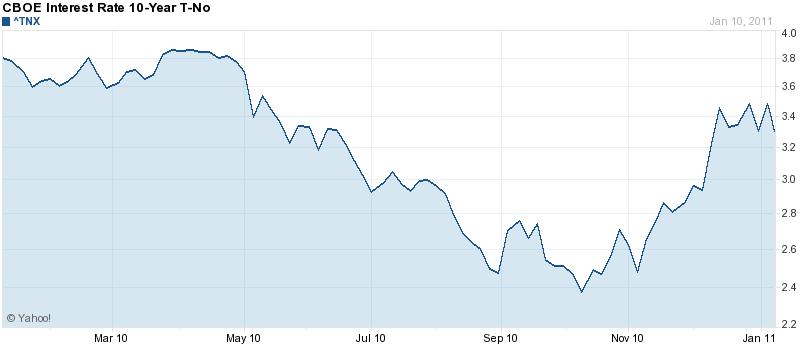
At the very least, this probably won’t hurt the Dollar, and certainly not to the extent that the market had priced in prior to QE2. While the stock market rally has stalled, the rise in Treasury Yields has not. The 10-Year rate is close to 3% for the first time in months, making it more attractive (and less costly) to hold capital in Dollar-denominated assets. The Dollar was also helped by the release of GDP data for Q3, during which the US economy beat expectations and grew by 2.5%.
10-Year Treasury Rate Vs. S&P 500 - 2006-2010
As a result, traders are reducing their Dollar-short positions. Analysts have revised their forecasts to reflect a stronger Dollar, based on the notion that “The dollar has found a bottom.” At this point, the main naysayers are “overwhelmingly found in the ranks of the opposition Republican party,” perhaps part of a cynical ploy to hurt both the economy and Barack Obama’s chances of being reelected.
To be sure, there may be other reasons for the Dollar’s rally, namely the growing turmoil in the EU. Evidence is mounting that the EU sovereign debt crisis is spreading, which has spurred both an increase in investor risk aversion and a decline in the Euro. Still, market chatter seems to be focusing less on the Dollar as safe-haven and more on the fact that the Dollar was merely oversold.
On a purchasing power parity (ppp) basis, the Dollar is starting to look cheap. If the opinions of Europeans, Canadian, Australian, and Japanese tourists are to be taken at face value, the US is cheaper than it has been for years. As one commentator summarized, “If the PPP figures are right, the U.S. dollar has more upside than the negative sentiment around it would indicate. If the greenback were to decline further, it would have to do so from an already undervalued situation.”

War = Good News for South Korea?

South Korea was in the midst of figuring out what to do with its appreciating Won when disaster struck, in the form of an unprovoked attack from North Korea. Combined with a worsening of the sovereign debt crisis in Europe, the news was enough to send the Won down 5% over the course of a couple weeks. From the standpoint of managing its currency, it looks like the (distant) prospect of war is actually a blessing in disguise.
Over the last decade, South Korea has been one of the world’s largest serial interveners in currency markets. Over the last two years alone, as evidenced by the growth in its foreign exchange reserves, it has spent more than $100 Billion defending the Won. As the so-called currency war has intensified, so, too has the Bank of Korea intensified its efforts to hold down the Won, having spent more than $20 Billion since July towards this effort.
South Korea Forex Reserves 2005-2010
You could say then that South Korea’s hosting of the G20 Summit on November 15 put it in a slightly awkward position. Still, it was determined to make clear that it would continue to take steps to combat the rise in the Won. According to Shin Hyun-song, the special economic advisor to President Lee Myung-bak, “This means that countries can intervene in the currency market when the market is in disorder and when there is a gap between the market rate and underlying economic fundamentals.” Of course, fundamentals is hardly an objective notion in this case.
While the G20 predictably called on participants to “move toward a market-driven exchange rate system and to refrain from competitive devaluations,” it nonetheless also guided them towards “implementing policy tools for bringing excessive external imbalances down to sustainable levels.” The underlying message is that certain countries should curtail their reliance on exports and try to achieve more balanced growth.
Naturally, South Korea’s interpretation was that while direct intervention is now taboo, taxes and other capital controls are sanctioned. Thus, it has been reported that “the Korean government has been gauging its timing to launch further measures to tighten the financial market and protect it from volatile global capital movement..bank levies on non-deposit liabilities and taxes on foreign purchases of government bonds are both possible options.”
As I said, though, the South Korea now has some breathing room. Its Won depreciated rapidly in the minutes after the shelling of Yeonpyeong island, which killed four and wounded 20, was first reported. The fact that the US government immediately pledged its support and solidarity (by sending over an aircraft carrier) is not instilling confidence. One analyst indicated, “We see a strong chance of further Korean won weakness in the days ahead as more details emerge, particularly if public opinion in South Korea puts pressure on the government there to take a stronger stance.”
Korean Won / US Dollar Chart
Even before this episode, the EU sovereign debt crisis had spread to Ireland, and put Spain and Portugal at risk, too. As a result, the Dollar-as-safe-haven mindset re-emerged, and spurred some capital movement back to the US. In this context, the drama with North Korea only exacerbated the climate of risk aversion.
Ultimately, both the EU fiscal crisis and the tensions with North Korea will subside, which should cause the Won to resume its rise. (In fact, Korean exporters have come to view this as inevitable, and have taken advantage of the relatively favorable exchange rate to repatriate overseas earnings). At this point, you can expect the Bank of Korea to begin implementing capital controls and continue the face-off with currency markets.

Asian Currencies Poised to Rise, but for Wrong Reasons

All things considered, Asian currencies have had an okay 2010 (and there’s still another month to go). After a modest first half, they started to rise in unison in June, and several are poised to finish the year 10% higher than where they began. While the last few weeks have seen a slight pullback, there is cause for cautious optimism in 2011.
Asian Currency Chart 2010
At this point, I think the rise in Asian currencies has become somewhat self-fulfilling. Basically, investors expect Asian currencies to rise, and the consequent anticipatory capital inflows cause them to actually rise, thereby reinforcing investor sentiment. For example, the co-head of emerging markets for Pacific Investment Management Company (PIMCO) is “investing in local currency debt and foreign exchange contracts in Asia on the basis that…emerging market currencies are bound to rise for…fundamental reasons.” Upon being asked to elaborate on such fundamentals, he answered lamely that, “One big driver for emerging markets in coming years will come from investors’ relatively low allocations to these fast-growing regions.”
When pressed for actual reasons, investors can glibly rattle off such strengths as high growth and low debt and wax bullish about the emerging market ‘story,’ but ultimately they are chasing yield, asset appreciation, and strengthening exchange rates. It doesn’t matter that P/E ratios for (Asian) emerging market stocks are significantly higher than in industrialized economies, or that bond prices are destined to decline as soon as (Asian) emerging market Central Banks begin lifting interest rates, or that Purchase Power Parity (PPP) already suggests that some of these currencies are already fairly valued. In a nutshell, they continue to pour money into Asia because that’s what everyone else seems to be doing.
Personally, I think that kind of mentality should inspire caution in even the most bullish of investors. It suggests that if bubbles haven’t already formed in emerging markets, they probably will soon, since there’s no way that GDP growth will be large enough to absorb the continuous inflow of capital. According to the Financial Times, “Data suggest that emerging market mutual funds, including those invested in Asian markets, have received about 10 per cent of their assets in additional flows over the past four to five months.” Meanwhile, a not-insignificant portion of the $600 Billion Fed QE2 program could find its way into Asia, exacerbating this trend.
US Dollar Asia Index 2010
In addition, emerging markets in general, and Asia in particular, have always been vulnerable to sudden capital outflow caused by flareups in risk aversion. For example, Asian currencies as a whole (see the US Dollar Asian Currency Index chart above) have declined 2% in the month of November alone, due to interest rate hikes in China and a re-emergence of the EU sovereign debt crisis. The former sparked fears of a worldwide economic slowdown, while the latter precipitated a decline in risk appetite.
As a bona fide fundamental analyst, it pains me to say that emerging market Asian currencies can expect some (modest) appreciation over the next year, barring any serious changes to the EU fiscal and global economic situations. It seems that capital will continue to pour into Asia, which – rather than fundamentals – will continue to dictate performance.

Canadian Dollar: Parity Vs Reality

After a stellar 2009, the Canadian Dollar (“Loonie”) has had a relatively lackluster 2010 against the Dollar, rising by only 3-4%. As the Loonie has inched (back) towards parity, it has encountered significant resistance. I think there is reason to believe that the currency has reached its limit, and that there are little prospects for further appreciation for at least the first half of 2011.
Canadian Dollar  Oil   Commodity Price Chart 2010
Everyone likes to think of the Canadian Dollar as a commodity currency, but I don’t think this is an accurate representation. Net energy exports account for only a small portion (2.9%) of Canadian GDP, a fraction which is dwarfed by the export of automobiles, for example. In fact, eastern Canada, which is comparatively poor in natural resources, is actually a net energy importer. I think that investors have largely come to the same conclusion, and significant rallies in oil and other commodity prices in the second half of 2010 spurred only a modest appreciation in the Loonie.
The currency has risen so fast over the last couple years that Canada has run a trade deficit for six consecutive months, including a record $2.5 Billion in July. (In some ways, doesn’t this prove that economic imbalances will ultimately self-correct?!). In addition, to say that Canadian export sector is heavily reliant on the US would be an understatement: “The U.S. bought 70 percent of Canada’s exports in October, down from 75 percent in June, and a record of about 85 percent in 2001.” It’s no wonder that Canadian economic officials have defended the Fed’s QE2 monetary easing program; they know that Canada’s economic health is contingent on a strong US economy.
As for how fluctuations in risk affect the Loonie, it’s not clear. On two separate occasions, the WSJ reported first that “With investors more willing to take on riskier assets than they were the day before, the Canadian dollar was able to move sharply higher,” and then that “Canada’s relatively strong fiscal and economic fundamentals attract safe-haven flows when investors are fleeing from risk.” What a blatant contradiction if there ever was one! Personally, I think that Canada’s economic structure and relatively high debt levels disqualify the Loonie from consideration as a safe-haven currency. That being said, it has notched some impressive gains against other non-safe haven currencies.
Canadian Dollar Versus Other Currencies November 2010
If not for its low interest rates, nobody would even mention it in the same breath as the US Dollar or Japanese Yen. Speaking of low rates, the Bank of Canada voted last week to keep its benchmark interest rate on hold at 1% and indicated that it won’t consider raising them for quite some time. Said Central Bank Governor Mark Carney, “There are limits to the divergence that there can be between Canada and the United States.” In other words, the BOC probably won’t hike rates until the Fed does, at which point there will be very little basis for buying the Loonie over the US Dollar.
Analysts tend to agree with this assessment: “The loonie will trade at parity by the end of March and weaken to C$1.01 per dollar through the end of third-quarter 2011, according to…a Bloomberg survey: ‘We still think the Canadian dollar will continue to hover around here and test parity; we don’t think the Canadian dollar is going to back up against the U.S. dollar until the new year.’ Interestingly enough, Canadian investment advisers echo this sentiment: “We’re saying to clients that the Canadian dollar is strong right now, so buying U.S. assets is cheaper than it would be if the dollar were weak.”
It’s a bad sign for the Loonie when even Canadians think it’s overvalued.

Japanese Yen Down on Risk Aversion

It seems the gods of the forex market read my previous post on the Japanese Yen, in which I puzzled over the currency’s appreciation in the face of contradictory economic and financial factors. Since then, the Yen’s 6-month, 15% appreciation (against the US Dollar) has arrested. It has retreated from the brink of record highs, and undergone the most significant correction since March of this year. Have investors come to their senses, or what?!
USD JPY Chart
You certainly can’t give the Bank of Japan (BOJ) any credit. Aside from its single-day $25 Billion intervention in September, it hasn’t entered the forex markets. In fact, it has already repaid the funds lent to it by the Ministry of Finance, which suggests that it doesn’t have any intention to replicate its earlier intervention in the immediate future, regardless of where the Yen moves.
Perhaps the BOJ foresaw the current correction in the Yen, which was probably inevitable in some ways. After all, Japanese interest rates – while gradually rising – still remain at levels that are unattractive to investors. While US short-term rates are low, long-term rates are more than 1.5% higher than their Japanese counterparts. When you factor in that Japan’s fiscal condition is worse than the US, there is really very little reason, in this aspect, to prefer Japan. As one analyst summarized, “The whole interest-rate differential argument is turning out to be dollar supportive, at least in the near term.”
The same is true for risk-averse capital. For reasons of liquidity and psychology, the Japanese Yen will continue to be a safe-haven destination in times of distress. Still, it’s hardly superior to the Dollar, in this sense. Inflation is slowly emerging (or at least, the risk of deflation is slowly abating) in Japan, and it could conceivably reach 1% this year if the Bank of Japan has its way. Its proposed 35 trillion yen ($419 billion) of asset purchases dwarfs the comparable Federal Reserve Bank’s QE2 program (in relative terms) and contradicts the notion that the Yen is the best store of value.
Japan Economic Structure - Dependence on Exports
Finally, the Japanese economy remains weak, and vulnerable to a double-dip recession. On the one hand, “Japan’s economy expanded at an annual 4.5 percent rate in the three months ended Sept. 30.” On the other hand, its economy remains heavily reliant on exports (see chart above, courtesy of Bloomberg News) to drive growth, which is complicated by the expensive Yen and concerns over a drop-off in demand from China and the rest of the world. In fact, “Exports rose 7.8 percent in October, the slowest pace this year, while industrial production fell for a fifth month and the unemployment rate climbed to 5.1 percent.” In addition, the closely watched Tankan survey registered a drop in September, “the first fall in seven quarters.” While Japanese companies are still net optimistic, analysts expect that this to change in the beginning of 2011.
For the rest of the year, how the Yen performs will depend largely on investor risk-appetite. If risk aversion predominates, then the Yen should hold its value. In addition, it’s worth pointing out that even as the Yen has fallen against the Dollar, it has appreciated against the Euro, and remained flat against a handful of other currencies. Against the US Dollar, however, I still don’t see any reason for why the Yen should trade below 85, and I expect the correction will continue to unfold.
JPY comparison chart 2010

Chinese Yuan: Appreciation or Inflation?

Based on nominal exchange rates, the Chinese Yuan has appreciated by a modest 2% against the US Dollar since the month of September (when the People’s Bank of China (PBOC) adjusted the currency peg for the first time in nearly two years). If you take inflation into account, however, the Chinese Yuan has risen by much more. In fact, if current trends persist, the Chinese Yuan exchange rate controversy might resolve itself.
CNY USD 1 year chart
Demands from the international community for China to appreciate its currency hinge on two related arguments. The first is that at its current level, the artificially low exchange has allowed China to build up a massive trade surplus. The second is that Chinese prices seem to be lower than they should be (when quoted in other currencies), and the economic principle of Purchasing Power Parity (PPP) suggests that for this discrepancy to be eliminated, the Chinese Yuan must rise.
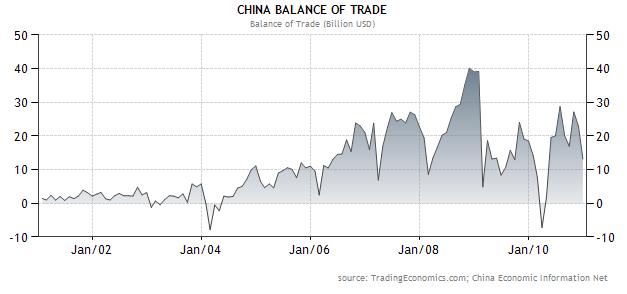
As it turns out, both of these claims are more problematic than they would appear. For example, China’s official trade surplus is already massive, and is steadily increasing. For 2010, it will probably near $200 Billion. However, it turns out that majority of that surplus is being captured by foreign-funded companies: “Their 112.5-billion U.S.-dollar surplus accounts for 66 percent of China’s total surplus over the past 11 months.”
In addition, trade statistics are calculated in such a way that the country that assembles the finished product gets credit for the full export value of that product. By looking specifically at Apple’s popular iPhone, researchers calculated that the product officially contributed $2 Billion to the US trade deficit with China. When the nuances of the iPhone’s supply chain are taken into account, that figure swings to a surplus of $48 million. In both of these cases, the fact that these products are manufactured in China doesn’t detract from US GDP (though it probably does cost the US jobs). Hence, the US probably isn’t hurting as much from the weak RMB to the extent that some lobbyists insist.
iPhone US China trade deficit
As for inflation, the official rate is now 5.1% on an annualized basis. Even if we accept this (and living in China, I can tell you that the actual rate is much, much higher), that means that the value of other currencies is eroding at a much faster rate than is implied by official exchange rates. That’s because a currency is only worth its purchasing power; as prices and wages in China rise, the purchasing power of the US Dollar (and other currencies) falls.
The Chinese government is trying to address the problem in the form of price controls and mandated increases in supply, but it is still reluctant to rein in inflation using conventional monetary policy measures. M2 money supply in China is increasing at a rate of 20% a year, the majority of which is being spent on another boom in fixed asset investment. While the PBOC has responded by increasing the required reserve ratio of Chinese banks, it remains reluctant to raise interest rates lest it contribute to further inflows of “hot money” on more upward pressure on the Yuan. As a result, the consensus among economists is that inflation will continue rising unabated: “We see a strong chance of underlying price pressures continuing to build over the medium-term.”
China inflation rate 2004-2010
Unless circumstances change, then, the argument for further RMB appreciation is somewhat weak. Nonetheless, analysts remain optimistic: “A Bloomberg survey based on the median estimates of 20 analysts predicts the yuan to increase 6.1 percent to 6.28 percent by the end of 2011.” Given that Hu Jintao is schedule to visit the US in January – and China’s fondness for symbolic policy gestures – a token move of 1% or so before then wouldn’t be surprising. As for the predicted 6% rise next year, well, that depends on inflation.

IPOs Raise Questions about the Future of Retail Forex

It has been said before, but now I think it’s official: retail forex has entered the mainstream. In the month of December, two retail forex brokerages – Forex Capital Markets (FXCM) and Gain Capital Holdings (GCAP) – went public on the New York stock exchange. Combined with some juicy information revealed in their regulatory filings, I think this event raises some interesting questions about the future of forex.
Some background: both FXCM and Gain Capital operate trading platforms and news/analysis websites (DailyFX.com and Forex.com, respectively). FXCM has a current market capitalization of $850 million, compared to $250 million for Gain Capital. The former earned net income of $98 million last year on revenue of $339 million, and it has 135,000 active clients. The latter earned $36 million net income on $188 million revenue, and its client base totals 52,000. (For the sake of comparison, consider that ETrade has more  than $4 million and its ttm revenues exceeded $2.5 Billion).
If you do some simple arithmetic, you will discover that revenue per account is substantially higher for forex brokers than for stock brokers: $2,500/account for  FXCM versus $100-200 that I’ve been told is standard for retail stock brokers. Of course, some of that disparity is natural, given that the average forex account-holder trades at a higher frequency and higher volume than the average stock investor, who apparently only makes one round-trip trade per month, on average. However, the bulk of that discrepancy is probably due to a lack of transparency/competition.
Although information on average account size was not released, it nonetheless stands to reason that a significant portion of forex account-holder equity is being “transferred” to brokers every year. (Interestingly, FXCM loses money on the majority of its accounts.  Accounts worth more than $10K – which presumably do the most trading – generate the most revenue, and yet more than half of them are still unprofitable for FXCM).
I think this raises some serious questions about transparency in forex commissions. While other brokers make money from the bid/ask spread (which also suffers from a lack of transparency) and by taking offsetting positions, FXCM boasts that it “makes an identical amount of money in the form of pip markups (which are really commissions) regardless of whether the customer made or lost money on the account.” Basically, FXCM matches up buyers/sellers with banks and financial institutions, and takes a cut for facilitating the transaction. While this is somewhat less opaque than filling orders directly for customers, the fact that it doesn’t disclose its commissions should be cause for concern. For the sake of comparison, consider that when you buy/sell stock, the commission that you pay the broker is clearly disclosed.
Someone recently asked me if trading commissions (i.e. spreads) in forex were fair/stable, and in the context of this data, I think it shows that there are is still room for commissions to fall. As the number of retail forex traders grows, you would expect spreads to tighten further, and profit/account to decline from the current level of $700+ per year.
Since both FXCM and Gain Capital are now public companies, they will be subject to increased scrutiny and regulatory oversight, and will henceforth be required to make frequent disclosures. If Oanda and other top-tier brokers accede to competitive pressures and also go public, the result should be increased transparency for the industry and better pricing for traders. In short, daily volume figures ($4 Trillion/day) notwithstanding, retail forex trading still has a ways to go before it can really be compared to retail stock trading.

Interview with Boris Schlossberg: “Risk control is EVERYTHING”

Today, we bring you an interview with Boris Schlossberg, director of currency research at GFT Forex, co-founder of BK Forex Advisors, and co-contributor to FX360. He is also a weekly contributor to CNBC’s Squawk Box and a regular commentator for Bloomberg radio and television. His daily currency research is widely quoted and appears in numerous newspapers worldwide. He is the author of Technical Analysis of the Currency Market (2006) and Millionaire Traders (2007). Below, Mr. Schlossberg shares his thoughts on risk management, leverage, currency wars, and other assorted topics.

Forex Blog: Can you briefly explain your approach to analyzing the forex markets. Do you prefer technical or fundamental analysis, or a combination of both?
I am primarily a fundamentally driven trader but I use price action to inform my trades as well, Specifically I focus on price action around the 00 levels to see if there is support/resistance there.
Forex Blog: How is your experiment to ignore real-time P&L going? Have you found that it has confirmed your belief in the Heisenberg principle and led to increased success in trading?
I have not had much of a chance to pursue that yet given the holidays, but I think just writing about the phenomena helped me to feel less pressured about the intra-day swing in my P&L.
Forex Blog: I was intrigued by your assertion that over the long-term, the tortoise may beat the hare in forex trading. What are the practical implications of this notion? Do you think it supports using fundamental analysis and adopting a more long-term approach to trading?
No the key is that risk control is EVERYTHING. As long as you can contain your losses, if you hang around the market long enough you will be able to catch positive swings regardless of whether you trade fundamentally or technically.
Forex Blog: When the Euro rallied in the beginning of the summer, a number of forex commentators (myself included) declared a paradigm shift, whereby investors would stop worrying about risk and instead focus on the fundamentals. Ultimately, this shift never materialized, and the Euro appears to have resumed its decline. What is your assessment of the Euro’s recent performance, and what can we expect for the immediate future?
Everybody hates the euro and there are certainly many reasons to do so, but I think that China will no allow the EZ to fracture and if that’s the case then euro may have a chance to bounce in 2011. My favorite way to play that is long EURGBP.
Forex Blog: You blogged recently about an encounter with an aspiring forex trader, in which you advised him to “There is only one way [to succeed in forex trading]. You open an account and just trade.” That being said, are there any practical tips that you can offer to novice forex traders?
There is no substitute for experience. They say you need 10,000 hours of practice to master a skill and I think that’s a fair metric to use.
Forex Blog:  It has been said that the Fed is caught in a lose-lose situation, whereby its QE2 will fail and the US economy will drift back into recession or it will succeed in invigorating the economy and stoking inflation. Do you share this interpretation?
No. There is deflation in US – not inflation. The Fed is doing is the only thing it can and so far it appears to have helped the economy.
Forex Blog: I agree with your assessment that high levels of dangerous leverage (~50:1) are a recipe for disaster. Do you support the recent regulatory changes that effectively cap the maximum amount of leverage on forex trades? Is there a general level of leverage that you think is acceptable, or is it specific to each trade?
Yes I agree with regulation. I myself trade with 3:1 leverage and never exceed 10:1.
Forex Blog: As you pointed out, “The Psychology of Round Numbers” is a phenomenon that is observable on all aspects of life in which numbers are involved. As far as forex is concerned, have you observed that round numbers are almost always a source of either support or resistance? How can traders predict whether a currency pair will stop at a given (round number) level or surge through?
If we could predict that with certainty we would never have to work again :) . That having been said I watch those levels very carefully and I see them at play every single day both as magnets for stop runs and as targets for turn trades against the trend.
Forex Blog: A discussion of the major themes in forex markets wouldn’t be complete without mentioning the ongoing currency wars. First of all, do you think that the label “currency war” is fair? Do you think that most countries’ Central Banks will continue to intervene on behalf of their respective currencies, and do you think they will succeed in  preventing them from rising further?
I think intervention is much more ingrained in Asia where export driven economies depend on low exchange rates. In the long run its a horrible strategy because it will inevitably lead to anti-competitive behavior. (Look how well Germany, Switzerland and Netherlands perform despite high exchange rates).
Forex Blog: What is your advice for (forex) investors that want to beat the market during these uncertain times?
Focus on one strategy that you are comfortable with and refine it continuously.

Forex Volatility Remains Abnormally High

If you look at a chart of currency volatility over the last five years, two major spikes immediately jump out. The first took place in the wake of the collapse of Lehman Brothers in late 2008, while the second occurred earlier this year during the height of the EU sovereign debt crisis. While volatility has gradually subsided since then, it is still well above its historical average, and many analysts forecast that it will remain at an elevated level through at least 2011.
G7 Currency Volatility 2006-2010
2010 was a volatile year for the forex markets for good reason. The EU sovereign debt crisis officially emerged, and spread from Greece to Ireland, and potentially to Portugal and Spain as well. There was uncertainty surrounding the impact of the Fed’s second quantitative easing program (QE2), as well as the impact of similar plans announced by the Bank of England and Bank of Japan. A handful of Central Banks ignited what has since been termed the “currency war,” which the G7/G20 are still trying to end. China allowed the Yuan to resume its upward march against the US Dollar, but at a pace that has failed to satisfy most critics. Emerging market currencies in general, and Asian currencies in particular surged, despite the best efforts of their respective Central Banks to contain them.
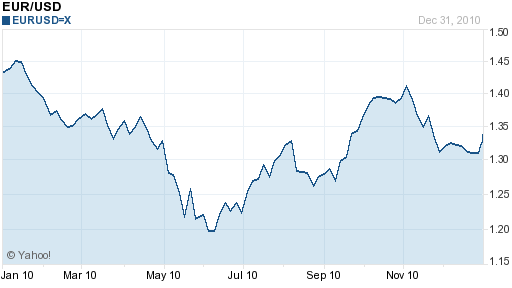
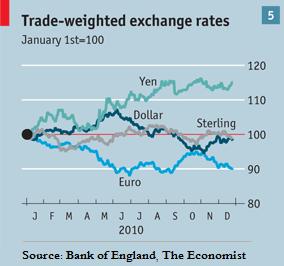
As a result, investors struggled to figure out what the right levels to buy and sell even the major currency pairs.  The Euro has ranged from $1.1877 to $1.4579 (against the Dollar) so far this year; and the Yen has ranged from 80.22 to 94.99. Amidst this backdrop of volatility, investors once again flocked to the US Dollar. On a trade-weighted basis, it appreciated 5% for the year. Against its arch-rival, the Euro, it gained an impressive 10%. The Japanese Yen and Swiss Franc – the other two major safe-haven currencies – also outperformed, even touching record levels against some other currencies.
US Dollar Index 2010
At this point, the only certainty is that uncertainty will persist well into 2011. Economic and monetary policymakers around the world will continue to struggle to keep (or merely put) their economies on the recovery track, while minimizing the risk of inflation in the medium-term. According to the currency strategy team at UBS, “There is…high risk of policy-maker error in relation to interest rates, quantitative easing and fiscal tightening.” To make matters worse, there is still a lack of coordination among, and in some cases, outright contradiction between countries’ respective policies. “There are doubts about the mutual consistency in economic strategies pursued by major economies…We have seen in recent weeks a tendency by countries to publicly challenge each others’ monetary or exchange rate policies,” said European Central Bank governing council member Christian Noyer.
As a result, it’s more than likely that volatility levels will remain proportionately high. Added UBS, “The euro may range from $1.1 and $1.5…and U.S. dollar may touch as low as 70 yen and high as 100 yen in 2011…Overall investors will have to be more aware of foreign exchange risk in 2011. For at least several more years, volatility will be structurally higher.”
In this kind of environment, the implications are clear. While commodity and emerging market currencies may still be girded by strong fundamentals, a lack of investor risk appetite could trigger another round of capital flight. Meanwhile, the US Dollar (and other safe haven currencies) will benefit, and the Euro will suffer.

Swiss Franc Surges to Record High(s)

In the last two weeks, the Swiss Franc rose to record highs against not one, not two, but three major currencies: the US Dollar, Euro, and British Pound. The Franc is now entrenched well above parity against the Dollar, and is closing in on the magical level of 1:1 against the Euro. With market uncertainty projected to run well into 2011, continued strength in the Franc is all but assured.
usd CHF 2 Year Chart
The Franc’s rise is due entirely to its being perceived as a safe haven currency. Its debt levels are comparable to other industrialized countries, its economy is in mediocre shape, and interest rates are the lowest in the entire world (the overnight lending rate is a paltry .1%). Some analysts have cited the “strong Swiss economic outlook” and “the health of Swiss public finances” as two factors buttressing its strength, but make not mistake: if not for the tide of risk aversion sweeping through the world’s financial markets, the Franc would hardly be attracting any attention.
As I have reported recently, the Dollar and the Yen have also benefited from the spike of risk aversion caused by renewed concerns over the fiscal health of the EU and the prospect of conflict in Korea. Perhaps owning to nothing more than proximity, the Franc has been the primary beneficiary from EU sovereign debt crisis. “It appears that smart money investors are pre-emptively bailing funds out of the eurozone with Switzerland providing a safe port to ride out the eurozone sovereign debt storm that appears to loom on the horizon,” summarized one analyst.
Unfortunately, it looks like the situation in the EU can only become serious. Despite a collective move towards fiscal austerity, all of the problem countries are still running budget deficits. As a result, members of the EU are set to issue no less than €500 Billion of new debt in 2011. To make matters worse, “The onslaught of credit warnings and downgrades of sovereign ratings over the past few days added to worries that borrowing costs in many euro zone nations could rise further.” This could trigger a self-fulfilling descent towards default and further buoy the Franc.
EUR CHF 2 Year Chart
As far as I can tell, the notion that, “Despite the Swiss franc’s recent sharp gains, we still believe there is plenty of room for further upside ahead,” seems to encapsulate current market sentiment. According to the most recent Commitment of Traders Report, investors continue to increase their long positions in the Franc. According to Bloomberg News, “Options traders are more bullish on the franc for the next three months than any major currency except the yen.” Meanwhile, a sample of analysts’ forecasts suggests that the Franc could appreciate another 5% over the next six months.
At this point, the main variable the Swiss National Bank (SNB), which could resume intervention on behalf of the Franc. After spending close to €200 Billion to depress the Franc, the SNB accepted the futility of its efforts and formally renounced intervention in June. However, Swiss National Bank President Philipp Hildebrand recently referred to the Franc’s rise as a “burden,” and warned that the SNB “would take the measures necessary to ensure price stability” in the event of  “renewed financial market tensions.”
As to whether intervention is likely, analysts remain divided. “The timing [for intervention] would certainly be perfect, with liquidity very thin….pre-holiday markets are ideal for springing a surprise,” said one strategist. According to Morgan Stanley, however, the SNB is “unlikely to intervene in the near term to stem the rise in the franc. The previous intervention earlier this year has left a huge overhang of liquidity in the economy and the Swiss National Bank doesn’t want to further boost the money supply.” In addition, the SNB experienced losses of €22 Billion on its forex reserves in the first nine months of this year, and will be reluctant to incur further losses by resuming intervention.
In short, aside from this lone point of uncertainty, all factors point to continued upside.

Brazilian Real Supported By Fundamentals, but Obstacles Remain

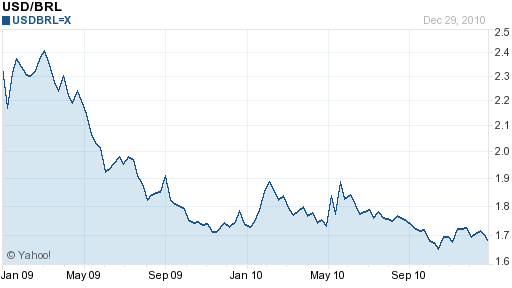
Despite all of the talk of currency war (a term first introduced by Brazili’s Finance Minister) and volatility in forex markets, the Brazilian Real is on pace to finish 2010 only slightly higher from where it began the year. While fundamentals would seem to support a further rise, Brazil’s government and Central Bank have made it clear that they will do everything in their combined power to prevent such an outcome. In short, the outlook for the Real in 2011 is incredibly uncertain.

There are two (somewhat contradictory) trends that have played a role in driving the Real to its current level. The first is the resurgence of the carry trade, whereby investors shift capital from low-risk, low-yield investments to higher-yield, higher-risk alternatives. With interest rates that are among the highest in the world – and certainly the highest among stable currencies – Brazil has been one of the prime recipients of carry trade funds. Since 2009, when concerns over the credit crisis began to ebb, the Real has risen a whopping 40%!
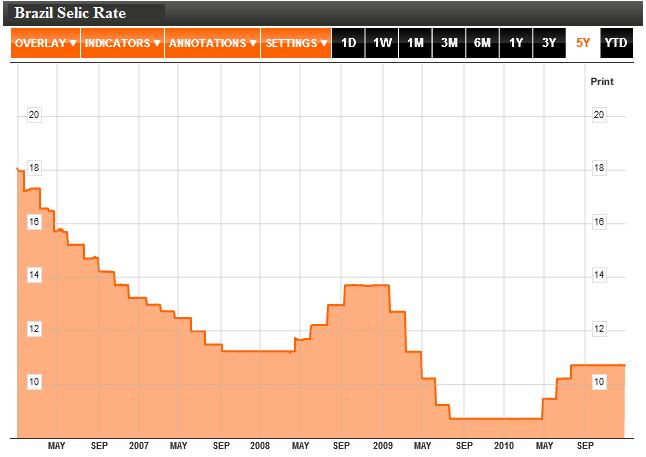
Moreover, the Central Bank might have no choice but to hike its benchmark Selic rate further over the next couple years. Inflation, at 5.5%, has already breached the Bank’s 4.5% target, and is projected to remain at an elevated level throughout 2011. According to futures prices, investors expect the bank to lift the Selic rate (currently at 10.75%) by 1.5% over the next twelve months, including a 50 basis point hike at its scheduled meeting in January. When you factor in low rates in the rest of the world, this would lift the yield spread between the Brazilian Real and most other comparable currencies to astronomical levels.
Alas, this first trend started to abate in the second half of 2010, due primarily to the EU sovereign debt crisis. Fortunately, the consequent move towards risk aversion hasn’t hurt the Real much. To be sure, Brazil is still an emerging-market economy, and is still perceived as being fraught with risk. However, when you consider that (certain) commodities prices (sugar, cotton) are at record highs and that the Brazilian economy barely dipped during the credit crisis, there are certainly riskier locales to park capital. Besides, many investors have determined that the interest rate premium that they receive from investing in Brazil is more than enough to compensate them for any added risk.
All else being equal, then, the Brazilian Real would probably continue rising at a measured pace in 2011. As I said, however, all else is not equal, since Brazil has pledged to do everything in their power to hold down the Real. According to the WSJ, “Earlier this year Brazil raised the IOF tax on foreign investment in fixed-income securities to 6% from 2% and also raised the tax for guarantees on derivatives investments.” Meanwhile, the Central Bank has intervened regularly in the spot market to purchase Dollars. The Bank’s newly appointed President, Alexandre Tombini, has voiced concerns over the Real’s rise: “We can’t let the economic policies of other countries determine the direction of foreign exchange.” On the day that he testified before the Senate’s Economic Affairs Committee, the Real fell by a substantial margin, suggesting that investors take his warnings seriously.
The Central Bank will also work closely with the new Brazilian administration to combat inflation, in a way that doesn’t cause the Real to appreciate. Rather than raise interest rates – which invites speculative capital inflows – the Bank will probably put pressure on the government to rein in spending and tighten access to credit. Over the long-term, this should allow it to lower rates to more sustainable levels, and prevent an expensive Rea from eroding the competitiveness of its export sector before it is too late.
Over the short-term, however, the immediate focus is to bring down inflation, most likely through rate hikes. That means that the Ministry of Finance will have to resort to more conventional weapons – such as taxes and intervention – to stem the Real’s rise. It managed to hold the Real to a 3% rise in 2010, but it remains to be seen whether it can repeat this feat in 2011.

Euro: Which Investors Know Best?

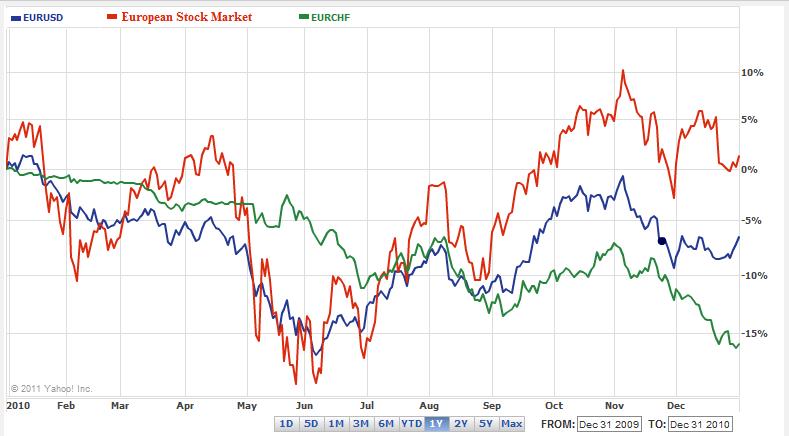
As the WSJ recently pointed out, there is a bizarre disconnect between equities and currency markets regarding the Euro. On the one hand, the Euro was the world’s worst performing major currency in 2010, and some analysts insist that its breakup is inevitable. On the other hand, stock market investors are increasingly bullish about Europe: “We remain positive on the outlook for [European] stocks in 2011, with a favorable macro backdrop, solid earnings and attractive valuations.” Who’s right?

In fact, both sets of investors are justified. As you would expect, stock market investors are focusing on corporate earnings and the macroeconomic environment. In this regard, the fact that the EU economy expanded in 2010 – buoyed by a cheap currency and loose monetary policy – should certainly be reflected in a stronger stock prices. On the other hand, the sovereign debt crisis in EU has not yet abated, and accordingly, it is still being priced into EUR/ exchange rates.
In the immediate short-term, it’s possible that stock market investors will prevail and that that their collective view will be adopted by currency markets. According to Deutsche Bank, “The euro may rise to $1.45 by the end of the first quarter of next year, as concerns about the single-currency area’s indebted periphery diminish.” Meanwhile, China recently pledged its support for the Euro via a promise to purchase up to €5 Billion in Portuguese Sovereign debt. Over the short-term, then, it’s possible that (currency) investors can be persuaded to temporarily forget about the prospect of default, and focus instead on the Eurozone’s nascent economic recovery.
Over the medium-term, however, the markets will have no choice but to  return their attention to the possibility of default, which is why the same team of analysts from Deutsche Bank “forecasts the euro will fall back to $1.40 by the end of the second quarter and to $1.30 by the year-end.” For example, Eurozone members will need to issue more than €500bn in debt in 2011, including €400bn that needs to be refinanced by Spain and Italy. In this context, China’s purchases will fade to the point of becoming trivial.
Meanwhile, Moody’s has warned that it could follow up on its 5-notch downgrade of Ireland’s sovereign credit rating with further downgrades for Spain and Portugal. Fitch added that it might bump Greece’s rating to junk status, which would deal a significant blow to its solvency. Default is now rapidly on course to becoming a self-fulfilling prophecy, as fleeing investors cause yields to rise and credit ratings to fall, further scaring away more investors.
The EU response has been to “set up a permanent mechanism from mid-2013,” while investors continue to push for an expansion of the European Financial Stability Facility or the joint issuance of European sovereign bonds. As a result, the Center for Economics and Business Research has issued a striking forecast that there is an 80% probability that the European Monetary Union will dissolve over the next decade: “If the euro doesn’t break up, this could be the year when it weakens substantially towards parity with the dollar.” Already, spot market traders are once again increasing their short bets for the Euro, and options trading remains “skewed toward euro puts.”

To be fair, some analysts continue to insist that it is better to think of the sovereign debt problems as a crisis of credit, rather than of currency. In that sense, there is hope that a solution can be engineered (perhaps encompassing a default) that doesn’t endanger the existence of the Euro. In addition, the Euro finished 2010 on a high note, formally welcoming Estonia into the fold. It is 10% above its June trough, including a 2% rise in the month of December. Given all of the bad news in 2010, that might just be cause for optimism.

Varied Forecasts for Canadian Dollar in 2011

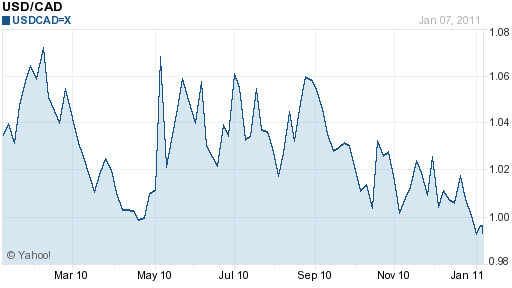
The Canadian Dollar (“Loonie”) recorded a fairly strong 2010. It appreciated 5.5% against the US Dollar, as an encore to a 16% gain in 2009. Moreover, its rise occurred with remarkably little volatility, fluctuating within a tight range of $0.99 – $1.08 (CAD/USD. It total, it rose against “seven of its major peers,” and “gained 4.4 percent over the past year in a measure of 10 developed-nation currencies, Bloomberg Correlation-Weighted Currency Indexes showed.” As for 2011, it is expected to continue trading close to 1:1 against the USD, though analysts differ over which side of parity it will tend towards.

At the moment, there are a few key fundamental trends driving the Loonie. As the WSJ encapsulated, the first factor is investor risk tolerance: “The fortunes of the risk-sensitive Canadian dollar in 2011 will be determined in large part by the issues driving global market fluctuations.”  Due primarily to the EU sovereign debt crisis, risk appetite continues to experience dramatic ebbs and flows. Based on conventional wisdom, risk averse investors should incline towards shunning the Loonie in favor of the US Dollar and other safe haven currencies. However, if you track the Loonie’s actual performance, you can see that concerns over global financial instability have hardly impacted it. Thus, bulls see this uncertainty as a force that “pushes investors to diversify their foreign exchange holdings by picking up some Canadian dollars.”
The second set of factors are macroeconomic. While slowing slightly in the second half of the year, the Canadian economy nonetheless exhibited a solid performance, which is expected to continue into 2011. Goldman Sachs, for example, “now sees growth accelerating to 3.3 per cent in the second quarter of this year, and 3.5 per cent in both the third and fourth quarters amid improving domestic demand.” However, the strong performance by natural resources and Canadian export strength that drove growth in 2010 could also be interpreted as a wild card in 2011, as the trade surplus narrows from a moderation in commodities prices and an expensive Canadian Dollar.
Finally, there is the continuing search for “value currencies” that is driving investors towards the Loonie. According to Bill Gross, manager of the world’s biggest bond fund, “It’s a critical strategy going forward to get…into some currency that holds its value…I’d suggest Mexico, Brazil or Canada as three examples of countries with good fiscal balance sheets.” It doesn’t hurt that the Bank of Canada was the first G7 central bank to raise interest rates, and that its benchmark interest rate compares favorably with the US Dollar, Yen, etc. Moreover, it is forecast to hike rates by an additional 50 basis points in 2011, beginning in the third quarter. On the other hand, it will still be a couple years before rates are high enough to make carry trading viable. Besides, long-term interest rates are currently higher in the US, which means that investors hungry for yield will ultimately have to find other reasons for shifting funds to Canada.
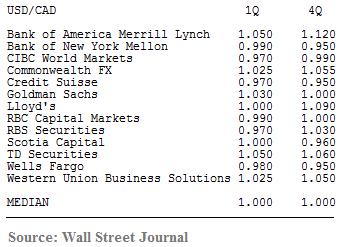
Forecasts for the Canadian Dollar in 2011 are extremely varied. If there’s any consensus, it is that barring any unforeseen developments, the Loonie will spend the year close to parity with the US Dollar. A couple analysts expect a big (downside) move, but the majority expects that regardless of which way the Loonie ultimately trends, it probably won’t be far removed from current levels. “The Bloomberg composite of 32 forecasts has the loonie spending most of the year at parity, then dipping slightly by the fourth quarter.” A similar WSJ survey shows a median forecast of 1:1 throughout the entire year.

Some analysts expect more movement in the currency crosses (i.e. against currencies besides the US Dollar). Given that the Canadian Dollar accounts for such a small portion of overall forex trading volume, however, it seems more likely that CAD cross rates will take their cues entirely from the USD and the rule of triangular arbitrage. (For example, if the Dollar rises against the Loonie but falls against the Aussie in 2011, the Loonie will necessarily also fall against the Aussie, regardless of whether fundamentals dictate such a movie).
I’m personally inclined to agree with the majority. There are many good reasons to buy the Loonie, but most of these were already priced in during the Loonie’s steady climb over the last two years. Going forward, I think that the US economy represents a double-edged sword that will prevent the Loonie from rising further. In short, if the US economy falters, so will the Canadian economy. If the US economic recovery gathers momentum, however, there will be good reason to buy the US Dollar in lieu of its counterpart to the north.

All Eyes on the US Dollar in 2011

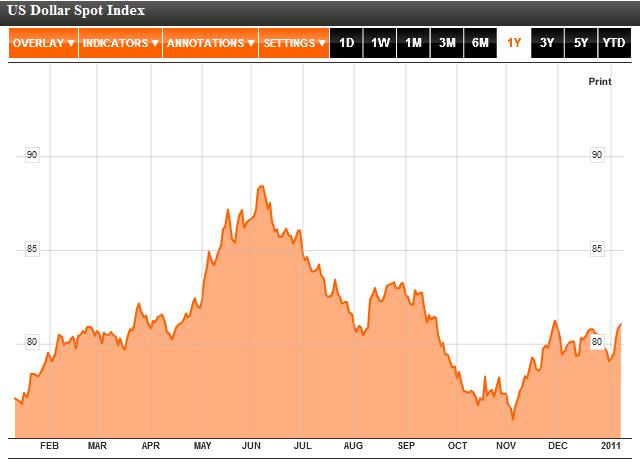
According to Standard Life Investments, the US Dollar will be one of the top currencies in 2011. (The other currency they cited was the British Pound). How can we understand this notion in the context of record high gold prices and commentary pieces with titles such as “Timing the Inevitable Decline of the U.S. Dollar?”
The Dollar finished 2010 on a high note, both on a trade-weighted basis and against its arch-nemesis, the Euro. Speculators are now net long the Dollar, and according to one analyst, it is now fully “entrenched in rally mode.” Never mind that its performance against the Yen, Franc, and a handful of emerging market currencies was less than stellar; given all that happened over the last couple years, the fact that the Dollar Index is trading near its recent historical average means that the bears have some explaining to do.
To be sure, none of the long-term risks have been addressed. US public debt continues to surge, and will not likely abate in 2011 due to recent tax cuts. Short-term interest rates remain grounded at zero, and long-term yields have only just begun to inch up, which means that risk-taking investors still have cause to shun the Dollar. Ironically, signs of economic recovery in the US have reinforced this trend: “The [positive economic] data, which one would ultimately assume is positive for the U.S., looks better for risk, which in turn puts downward pressure on the dollar.” Finally, the the Financial Balance of Terror makes the US vulnerable to a sudden decision by Central Banks to dump the Dollar.
So what’s driving the Dollar in the short-term? The main factor is of course continued uncertainty in the Eurozone over still-unfolding fiscal crisis, which is directly driving a shift of capital from the EU to the US. Next, the budget-busting tax cuts that I mentioned above are predicted to both boost economic growth and make it less likely that the Federal Reserve Bank will have to deploy the entire $600 Billion that it initially set aside for QE2. (To date, it has spent “only” $175 Billion in this follow-up campaign, compared to the $1.75 Trillion that it deployed in QE1). According to The Economist, “JPMorgan raised its growth forecast for the fourth quarter of next year to 3.5% from 3% as a result [of the tax cuts]. Macroeconomic Advisers, a consultancy, says the new package could raise growth to 4.3% next year, up from its current forecast of 3.7%.”

In fact, long-term rates on US debt have started to creep up. They recently surpassed comparable rates in Canada, and even risk-taking investors are taking notice: “U.S. bond yields are attractive and interesting again,” indicated one analyst. Of course, when analyzing the recent increase in bond yields, it’s impossible to disentangle inflation expectations from concerns over default from optimism over economic. Nevertheless, the consensus is that rates/yields can only rise from here: “The CBO [Congressional Budget Office] estimates that interest rates on 3-month bills and 10-year notes will reach 5.0% and 5.9%, respectively, by 2020.”
As if this wasn’t enough, the exodus out of the US Dollar over the last few decades has virtually ceased, with the US Dollar still accounting for a disproportionate 62.7% of global forex reserves. Furthermore, economists are now coming out of the woodwork to defend the Dollar and argue that its supposed demise is overblown. At last week’s annual meeting of the American Economic Association (and in a related research paper), Princeton University economist Peter B. Kenen “argued that neither Europe’s nor China’s currency presents a valid substitute–nor an International Monetary Fund alternative to the dollar that was created some 40 years ago.” Even if the RMB was a viable reserve currency – which it isn’t – Kenen points out that for all its bluster, China has shied away from taking a more active leadership role in solving global economic issues.
In short, as I’ve argued previously, the Dollar is safe, not just for the time being, but probably for a while.

Japanese Yen Due for a Correction in 2011

Based on every measure, the Japanese Yen was the world’s best performing major currency in 2010. It notched up gains every one of its 16 major counterparts, and was the only G4 currency to appreciate on a trade-weighted basis. Against the US Dollar, it rose 10%, and touched a 15-year high in the process. However, there is reason to believe that the Yen is now overvalued, and that 2011 will see it decline to more sustainable levels.

I am still somewhat baffled as to why the Yen has risen so inexorably. It is said that “Hindsight is 20/20,” but in this case the benefit of hindsight doesn’t really provide any additional clarity. Of course, there was the Eurozone Sovereign debt crisis and the consequent shift of funds into safe-haven currencies, but let’s not forget that the fiscal problems of Japan are even more pronounced than in the EU. Premiums on credit default swaps signal that the probability of a Japanese government default is twice as high as it is for the US, and there are rumors of a downgrade in its sovereign credit rating. As one commentator summarized, “Just how the Japanese have got away with running up a debt to GDP ratio of over 200% (higher than the PIIGS and the U.S.) is beyond me.” Of course, it helps that this debt is financed almost entirely by domestic savings and is consequently not vulnerable to the changing whims of foreigners, but even so!
Meanwhile, the opportunity cost of investing in Japan is high. While inflation is moot, equity returns are low and bond yields are even lower. “Japanese 10-year yields, the lowest among 32 bond markets tracked by Bloomberg data, will end 2011 at 1.24 percent from 1.19 percent today, according to a weighted forecast of economists surveyed by Bloomberg News.” Combined with low short-term rates, it would seem that the Japanese Yen would be the perfect candidate for a carry trade strategy.
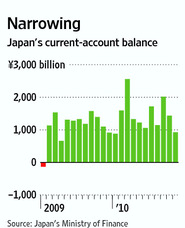
Although foreigners remain net buyers of Japanese Yen, the current account/trade surplus is gradually narrowing, with the former falling 16% year-over-year and the latter dropping 46%. It seems that “consumers overseas increasingly spurn Japanese products in favor of lower-priced goods from South Korea and other nations.”

Even the Japanese seem to prefer other currencies. According to NIKKEI, “Japanese investors were net buyers of foreign mid- and long-term bonds to the tune of 21.94 trillion yen in 2010, the most since comparable data began being compiled in January 2005.” Japanese companies are also taking advantage of the expensive Yen and strong balance sheets to buy overseas assets. The Economist reports that, “Japanese companies are sitting on a hoard of cash totalling more than ¥202 trillion ($2.4 trillion)…Many companies have earmarked vast sums for acquisitions in 2011 and beyond.”
With GDP projected to fall to 1% in 2011, there would seem to be very little reason to continue buying the Yen. According to the most recent CFTC Commitment of Traders Report, speculators are building up massive short positions in the Yen. Meanwhile, the Central Bank of China is quietly paring down its Yen holdings. Even the Bank of Japan seems to have embraced this inevitability, as it is has already stopped intervening in forex markets on the Yen’s behalf.
According to a Bloomberg News Survey, “Japan’s currency will tumble almost 10 percent against the dollar this year.” Very few analysts think that the bottom will complete fall out from under the Yen, but the majority (myself included) expect a correction of some kind.

Fed Paper: Power of Technical Analysis in Forex is Declining

Being a practitioner of fundamental analysis, you could say that I’m always on the lookout for hard evidence that fundamental analysis is superior to technical analysis. Thus, I was delighted to discover a working paper (“Technical Analysis in the Foreign Exchange Market“) by the St. Louis Branch of the Federal Reserve Bank, released just this month. Alas, the paper barely touched upon fundamental analysis, but its conclusions on technical analysis in the currency markets were startling. In short, the effectiveness of technical analysis in the currency markets has declined steadily since the 1970s, such that only the most sophisticated/complicated strategies are currently profitable.
Rather than conduct original research, the report’s authors – Christopher J. Neely, an assistant vice president and economist at the Federal Reserve Bank of St. Louis, and Paul A. Weller, the John F. Murray Professor of Finance at the University of Iowa – performed a meta analysis of the existing research. They cited a litany of studies, covered a variety of topics, sometimes with contradictory conclusions. In order to ensure comprehensiveness, they looked at the profitability of numerous types of technical analysis indicators, across numerous currency pairs, over time, in different types of trading environments, and adjusted for risk.
All of the earlier studies, dating back to the 1960s, established the profitability of technical analysis, even when it was simplistic. Since then, however, most studies have shown steadily declining effectiveness: “TTRs [Technical Trading Rules] ere able to earn genuine risk-adjusted excess returns in foreign exchange markets at least from the mid-1970s until about 1990…and that rule profitability has been declining since the late 1980s.” The same trend has unfolded in the last decade, as traders have relied increasingly on computerized trading strategies: “Kozhan and Salmon (2010), using high frequency data, find that trading rules derived from a genetic algorithm were profitable in 2003 but that this was no longer true in 2008.”
Given that the two authors also concede that the financial markets are undoubtedly inefficient and that currency markets in particular are filled with observable trends, how should we understand this decline in the effectiveness of technical analysis? In one word, the answer is competition. “Profit opportunities will generally exist in financial markets but…learning and competition will gradually erode ["arbitrage away"] these opportunities as they become known.” In addition, there has been a “dramatic rise in the volume of algorithmic trading,” which has given rise to a so-called financial arms race to develop ever-more sophisticated trading strategies.
Indeed, the research shows that “more complex strategies will persist longer than simple ones. And as some strategies decline as they become less profitable, there will be a tendency for other strategies to appear in response to the changing market environment.” In addition, technical analysis that is used to trade exotic (i.e. less liquid) currencies is more likely to be profitable than major currencies, especially the US Dollar.
The report opens the door to further research, by indicating that “Technical trading can be consistently profitable in certain circumstances.” As if it wasn’t already clear, though, the vast majority of technical traders (perhaps all traders for that matter) are destined to be outmaneuvered and will ultimately lose money trading forex. Another way of looking at this, however, is that the the savviest traders – those that can spot complex trends and execute trading strategies quickly – still have a chance at earning consistent profits.

Chinese Yuan Continues to Tick Up

At the very end of 2010, the Chinese Yuan managed to cross the important psychological level of 6.60 USD/CNY, reaching the highest level since 1993. Moreover, analysts are unanimous in their expectation that the Chinese Yuan will continue rising in 2011, disagreeing only on the extent. Since the Yuan’s value is controlled tightly  by Chinese policymakers, forecasting the Yuan requires an in-depth look at the surrounding politics.
While American politicians chide it for not doing enough, the Chinese government nonetheless deserves some credit. It has allowed the Yuan to appreciate nearly 25% in total, which should be just enough to satisfy the 25-40% that was initially demanded. Meanwhile, over the last five years, China’s trade surplus has fallen dramatically, to 3.3% of GDP in 2010, compared to a peak of 11% in 2007. In fact, if you don’t include trade with the US, its surplus was basically nil this year.
Therein lies the problem. Despite the fact that prices in Chinese exports should have risen 25% (much more if you take inflation and rising wages into account) since 2004, the China/US trade balance has remained virtually unchanged, and its current account surplus has actually widened. As a result, China’s foreign exchange reserves increased by a record amount in 2010, bringing the total to a whopping $2.9 Trillion! (Of course, these reserves should be thought of as a monetary burden rather than pure wealth, to the same extent as the US Federal Reserve Board’s Balance Sheet must one day be wound down. In the context of this discussion, however, that might be a moot point).
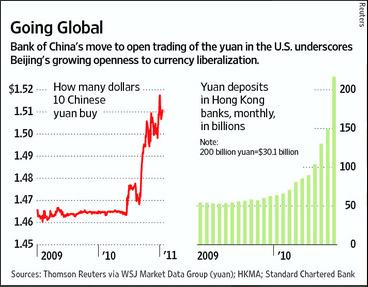
Meanwhile, China is trying to slowly tilt the structure of its economy towards domestic consumption, which is increasing by almost every measure. Its Central Bank is also slowly hiking interest rates and raising the reserve requirements of banks in order to put the brakes on economic growth and rein in inflation. Finally, it is trying to encourage internationalization of the Yuan. There now 70,000 Chinese trade companies that are permitted to settle trades in Chinese Yuan. In addition, Bank of China just announced that US customers will be able to open up Yuan-denominated accounts, and the World Bank became the latest foreign entity to issue an RMB-denominated “Dim-Sum Bond.”

There is also evidence that the Chinese Government’s top leadership – with whom the US government directly negotiates – is actually pushing for a faster appreciation of the RMB but that it faces internal opposition. According to the New York Times, “The debate over revaluing the renminbi… has not advanced much partly because of a fight between central bankers who want the currency to rise and ministers and party bosses who want to protect the vast industrial machine that depends on cheap exports for survival.” In fact, the Bank of China (PBOC) recently warned, “Factors such as the country’s trade surplus, foreign direct investment, China’s interest rate gap with Western countries, yuan appreciation expectations, and rising asset prices are likely to persist, drawing funds into the country,” while a senior Chinese lawmaker pushed back that a “rise in the yuan’s value won’t help the country to curb inflation.”
Some analysts expect a big move in the Yuan that corresponds with this week’s US visit by China’s Prime Minister, Hu Jintao. The average call, however, is for a continued, steady rise. “China’s currency will strengthen 4.9 percent to 6.28 by the end of 2011, according to the median estimate of 19 analysts in a Bloomberg survey. That’s over double the 2 percent gain projected by 12-month non-deliverable forwards.” As I wrote in my previous post on the Chinese Yuan, however, it ultimately depends on inflation – whether it keeps rising and if so, how the government chooses to tackle it.

Aussie May Have Peaked in 2010

When offering forecasts for 2011, I feel like I can just take the stock phrase “______ is due for a correction” and apply it to one of any number of currencies. But let’s face it: 2009 – 2010 were banner years for commodity currencies and emerging market currencies, as investors shook off the credit crisis and piled back into risky assets. As a result, a widespread correction might be just what the doctor ordered, starting with the Australian Dollar.
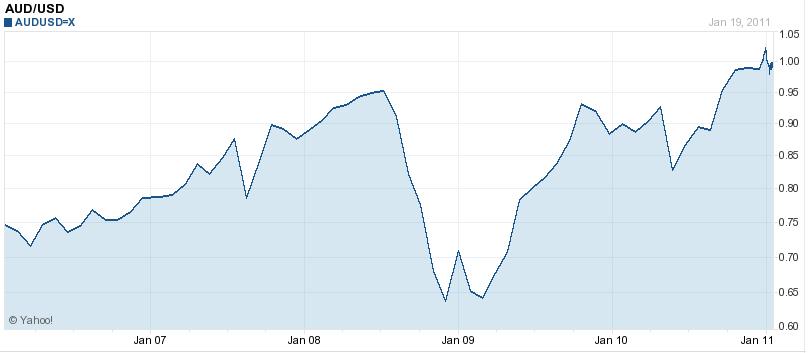
By any measure, the Aussie was a standout in the forex markets in 2010. After getting off to a slow start, it rose a whopping 25% against the US Dollar, and breached parity (1:1) for the first time since it was launched in 1983. Just like with every currency, there is a narrative that can be used to explain the Aussie’s rise. High interest rates. Strong economic growth. In the end, though, it comes down to commodities.
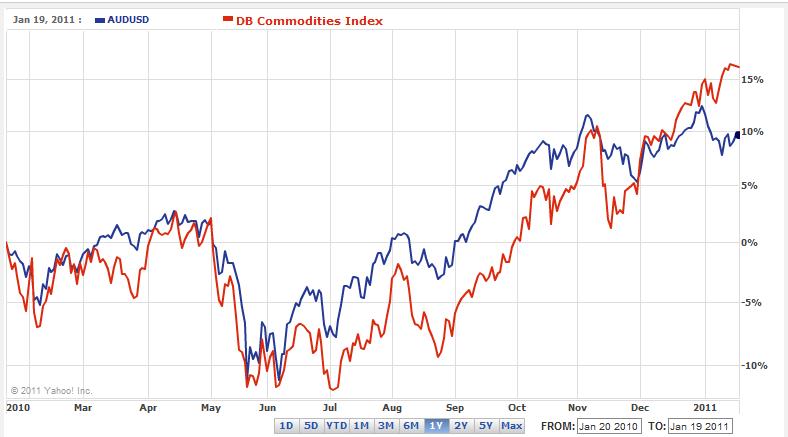
If you chart the recent performance of the Australian Dollar, you will notice that it almost perfectly tracks the movement of commodities prices. (In fact, if not for the fact that commodities are more volatile than currencies, the two charts might line up perfectly!) By no coincidence, the structure of Australia’s economy is increasingly tilted towards the extraction, processing, and export of raw materials. As prices for these commodities have risen (tripling over the last decade), so, too, has demand for Australian currency.
To take this line of reasoning one step further, China represents the primary market for Australian commodities. “China, according to the Reserve Bank of Australia, accounts for around two-thirds of world iron ore demand, about one-third of aluminium ore demand and more than 45 per cent of global demand for coal.” In other words, saying that the Australian Dollar closely mirrors commodities prices is really an indirect way of saying that the Australian Dollar is simply a function of Chinese economic growth.
Going forward, there are many analysts who are trying to forecast the Aussie based on interest rates and risk appetite and the impact of this fall’s catastrophic floods. (For the record, the former will gradually rise from the current level of 4.75%, and the latter will shave .5% or so from Australian GDP, while it’s unclear to what extent the EU sovereign debt crisis will curtail risk appetite…but this is all beside the point.) What we should be focusing on is commodity prices, and more importantly, the Chinese economy.
Chinese GDP probably grew 10% in 2010, exceeding both economists’ forecasts and the goals of Chinese policymakers. The concern, however, is that the Chinese economic steamer is now powering forward at an uncontrollable speed, leaving asset bubbles and inflation in its wake. The People’s Bank of China has begun to cautiously lift interest rates, raise reserve ratios, and tighten the supply of credit. This should gradually trickle down in the form of price stability and more sustainable growth.
Some analysts don’t expect the Chinese economic juggernaut to slow down: “While there is always a chance of a slowdown in China, the authorities there have proved remarkably adept at getting that economy going again should it falter.” But remember- the issue is not whether its economy will suddenly falter, but whether those same “authorities” will deliberately engineer a slowdown, in order to prevent consumer prices and asset prices from rising inexorably.
The impact on the Aussie would be devastating. “A recent study by Fitch concluded that if China’s growth falls to 5pc this year rather than the expected 10pc, global commodity prices would plunge by as much as 20pc.” [According to that same article, the number of hedge funds that is betting on a Chinese economic slowdown is increasing dramatically]. If the Aussie maintains its close correlation with commodity prices, then we can expect it to decline proportionately if/when China’s economy finally slows down.

Latin America Enters Currency War

A few years ago, I wouldn’t deign to discuss such obscure currencies as the Chilean Peso and the Peru New Sol. But this is a new era! These currencies – and their Central Banks – are being thrust into the spotlight as they join more established Latin American countries in the fight to contain currency appreciation.

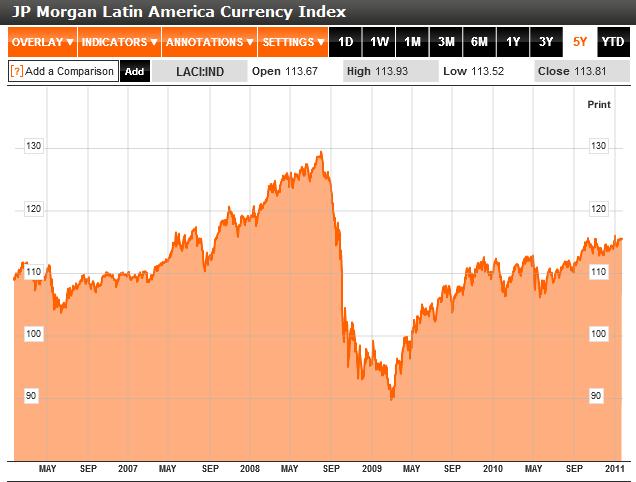
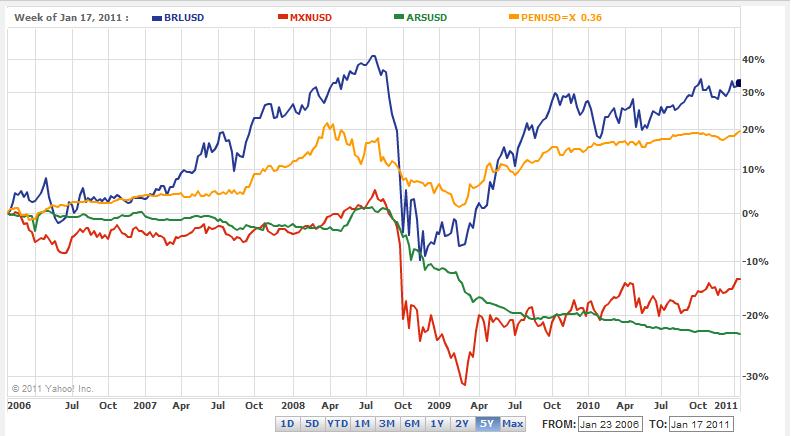
Major Latin American currencies have collectively appreciated more than 29% since March 2009. (When researching this post, I discovered the fantastically apropos JP Morgan Latin American Currency Index, which is based on the currencies of Mexico, Columbia, Brazil, Argentina, Peru, and Chile, and is displayed in the chart above). That includes a nearly 45% gain in the Brazilian Real and a 30% rise in the Mexican Peso, with more modest gains by the Peru New Sol, Chilean Peso, and Colombian Peso. The Argentinean Peso seems to be dragging the entire index down, having never recovered from the sovereign debt default in 2008.
Over this period, capital has poured into Latin America: “Net private inflows surged to $203.4 billion last year from $57.5 billion in 2003, according to the World Bank. Stock market indices in the region are closing in on all-time highs, and bond prices have risen (i.e. 32% gain in Colombian bonds in 2010) to such an extent that spreads to Treasury Securities – the most common comparison – have narrowed to record lows. Perhaps this not for naught, as the region recorded economic growth of 5.7% in 2010 on the basis of rising commodities prices, aggressive/fiscal policies, and an overall global economic recovery.
Faced now with rising inflation (6% in Brazil, 4.5% in Chile, 11%+ in Argentina, etc.) and declining export competitiveness, Latin American countries have moved to stem the appreciation of their respective currencies. Brazil, whose finance minister coined the term ‘currency war’ and has been one of the most aggressive interveners in the forex markets, has been the most active. Its Central Bank continues to buy massive quantities of Dollars, it has raised taxes on capital controls, and most recently it moved to limit the ability of banks to short Dollars as a means of betting on the Real’s appreciation.
Meanwhile, “Chile, which hadn’t bought dollars in the foreign-exchange market since 2008, announced Jan. 3 it would purchase a record $12 billion, equal to 43 percent of the country’s currency reserves. In Colombia…the central bank is buying at least $20 million a day in the spot market. Peru purchased $9 billion last year, the second-biggest amount ever. While Mexico has so far refrained from intervention, it recently negotiated an IMF credit line which it could potentially tap for the purpose of holding down the Peso. All together, the Central Bank reserves of the six currencies mentioned above rose 16.5% in 2010 and now exceed $500 Billion.
It’s difficult to discern whether this intervention is having any impact. On the one hand, the raising of reserve requirements will certainly make it difficult for domestic banks to short their own currencies. In addition, some foreign speculators are getting spooked about all of the uncertainty and have moved to limit their exposure to Latin America. “There might be every macro reason in the world to love the Brazilian currency, but the randomness of policy to try and stop appreciation makes us want to have a smaller position,” explained one fund manager.
On the other hand, there is the possibility that legitimate institutional investors will also be scared away, which is problematic because Latin America remains reliant on foreign capital to fund its lavish fiscal spending and growing trade deficits. “There’s always a danger that by having capital controls, you can force some good capital to stay out of the country,” summarized one analyst. There are also concerns that Central Banks are losing sight of the bigger picture: “Central banks view the level of exchange rates as the priority rather than using them to help slow inflation.”
The problem, ultimately, is that Latin American countries want to have their cake and eat it too. The President of Colombia spoke recently of 5% GDP growth and the country’s desire to “put itself in the coming years among the most dynamic economies in the world,” but has whined about the upward pressure on the Peso. Brazil’s newly elected president has also spoken of becoming a global economic leader while its Finance Minister continues to sound off on the currency war. Meanwhile, Chile’s economy remains heavily tilted towards copper exports (it is apparently the world’s largest producer), and then wonders why rising prices have lifted the Chilean Peso. All blame the Fed’s Quantitative Easing Program for their currency woes and use China’s currency peg as basis for intervention.

In short, the appreciation of Latin American currencies has largely mirrored fundamentals. Individually and as a group, their exchange rates are still well below the bubble levels of 2008. Most of the rise over the last two years has merely offset the precipitous declines that took place during the height of the credit crisis. In addition, given the divergence in performance between individual currencies, it’s clear that investors (whether speculative or passive) are discerning. They have flooded the commodities producers with cash, while continuing to punish Mexico and Argentina over fiscal issues.
For that reason, there is reason to believe that most of the region’s currencies will continue to appreciate. Central Banks might manage to stall that appreciation in the short-term, but once they accept the inevitability of interest rate hikes (as Brazil already has) as the cure for inflation, the long-term upward path will be restored. Summarized one economist, “In these games of cat and mouse, I think policy makers will probably lose. There is too much unregulated capital in the world, particularly in developed countries. These guys will find ways around various restrictions.”